
CREATOR PRODUCT SELECTION
What Should a Creator Sell First? Choose a Product Your Audience Already Wants
Choose your first creator product with an audience-fit checklist. Compare demand signals, samples, delivery costs and buying intent before a small launch.
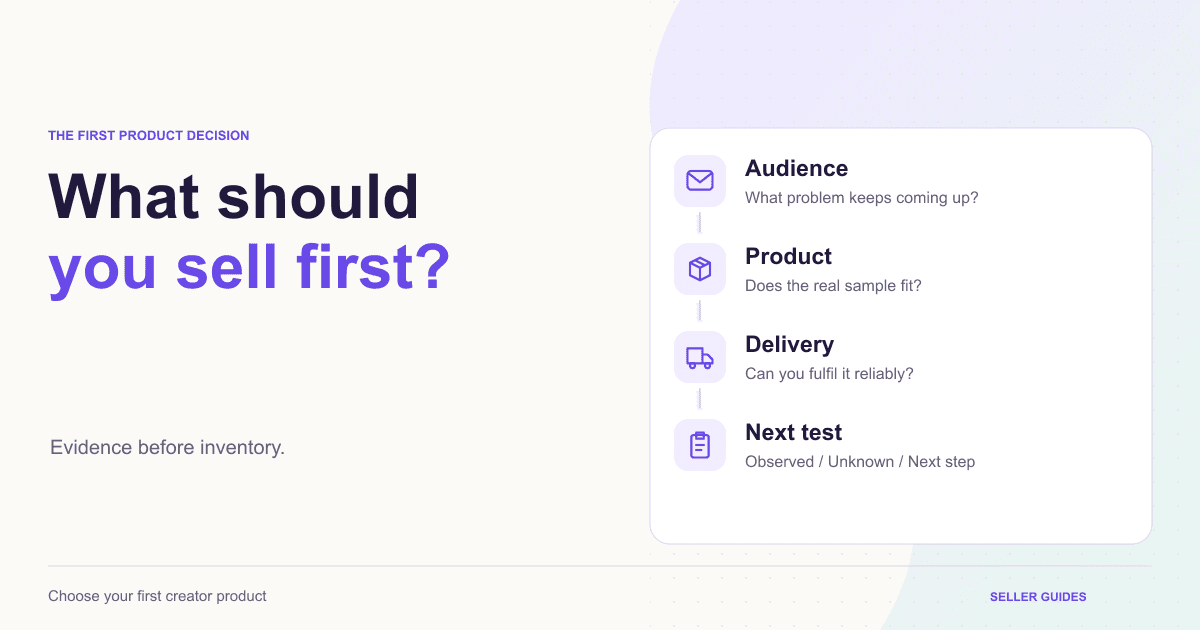
The first product to sell as a creator should fit a problem your audience recognises, be something you can demonstrate honestly, and be practical to deliver. A trending product is an idea, not proof that your followers will buy it. For Indian creators selling physical products, packaging, prepaid or COD orders and customer support also belong in the decision. Start with one manageable offer, not a catalogue.
Start With Questions, Not Trends
Review repeated audience questions and record the task behind them: organising a small desk, preparing lunch for work or keeping travel accessories together. Ask what people currently use and what frustrates them. Compliments and poll votes are not purchase commitments.
Check who actually needs the product. A student audience may enjoy a premium home-office demonstration without wanting to buy the item. Define the buyer before selecting a supplier.
Explore the creator-selling approach to connect relevant content with a clear buying path.
Shortlist Three Explainable Ideas
Describe each idea in one sentence: this helps a particular person complete a particular task. A desk-setup creator might compare a cable organiser, storage tray and laptop sleeve. These are hypothetical starting points, not proven winners.
Prefer something you can demonstrate without exaggerated claims. Explain dimensions, limitations and everyday use. Your audience should understand why the product fits their situation, not just recognise your name on its packaging.
Inspect Samples Before Launching
Test actual samples for finish, dimensions, packaging and consistency. A supplier photograph cannot establish what your customer will receive. Check the exact use you intend to demonstrate.
Keep the initial range manageable. More sizes, colours and bundle combinations create more decisions and packing risks. Unfamiliar health, food or cosmetic products also introduce safety, claims and compliance questions that need appropriate expertise; do not copy supplier promises uncritically.
Check Delivery and Costs
Pack a sample, record its dimensions and weight, and check delivery coverage and current provider quotes. Consider breakage or leakage. Include product, packaging, shipping you absorb, payment charges, handling, potential returns and any advertising in your planning. Purchase cost versus selling price is not automatically profit.
Consider COD and prepaid separately: a placed COD order is not collected revenue. Decide who checks orders, answers delivery questions and resolves exceptions before accepting purchases.
Review the order-management workflow when assigning responsibility for each post-purchase step.
Compare Evidence, Not Guesswork Scores
Make an Audience, Product and Delivery card for each idea. Under each area, record what you observed, what remains unknown and the next useful test. This is a planning tool, not a validated scoring system.
For a cable organiser, repeated questions suggest a problem; sample testing may reveal that thick cables do not fit; delivery quotes may still be missing. Ask which cables followers use, show the limitation and complete the shipping check. An unanswered question should not become a positive score.
Test One Honest Offer
Show the real sample, intended price, included items and limitations. Ask what would stop someone buying. If collecting interest through a form, explain that it is not an order. Accept purchases only when you can fulfil them, with accurate availability and timelines.
Separate interest, clicks, placed orders, collected payments and delivered orders. Record objections alongside purchases, and avoid drawing broad conclusions from a tiny sample. Fix recurring problems before expanding the range.
Give the offer one clear destination through your creator Store Link, keeping its name, imagery and promise consistent with your content.
Review the mobile experience at branded checkout so buyers can understand the total, payment choices and delivery expectations.
Prepare Your First Buying Path
Start SellSnap AI's 7-day free trial to prepare your offer and evaluate its mobile purchase journey. The trial helps you assess the workflow; it does not guarantee sales.
Compare SellSnap AI plans against your launch needs before committing.
BUILD YOUR SELLING SYSTEM
Ready to turn your product story into a focused funnel?
Start a seven-day free trial and build your product funnel, branded checkout and selling operations in one place.
Start your free trialRELATED SELLSNAP AI FEATURES
FAQ
Frequently asked questions
Do I need a large following?
Follower count alone does not establish demand. Test a relevant offer at a scale you can afford and fulfil reliably.
Should I sell merchandise or a functional product?
Merchandise relies on affinity with your identity; a functional product must perform a useful job. Validate the buying reason rather than assuming either always wins.
Should I buy a large batch for a discount?
A lower unit price does not remove demand or quality uncertainty. Check samples and the total commitment before deciding on an initial quantity.