PRODUCT FUNNELS
How to Build a Product Funnel That Converts: A Practical Guide for DTC Sellers
Learn how to build a conversion-focused product funnel with the product story, offer, checkout and post-purchase steps DTC sellers need.
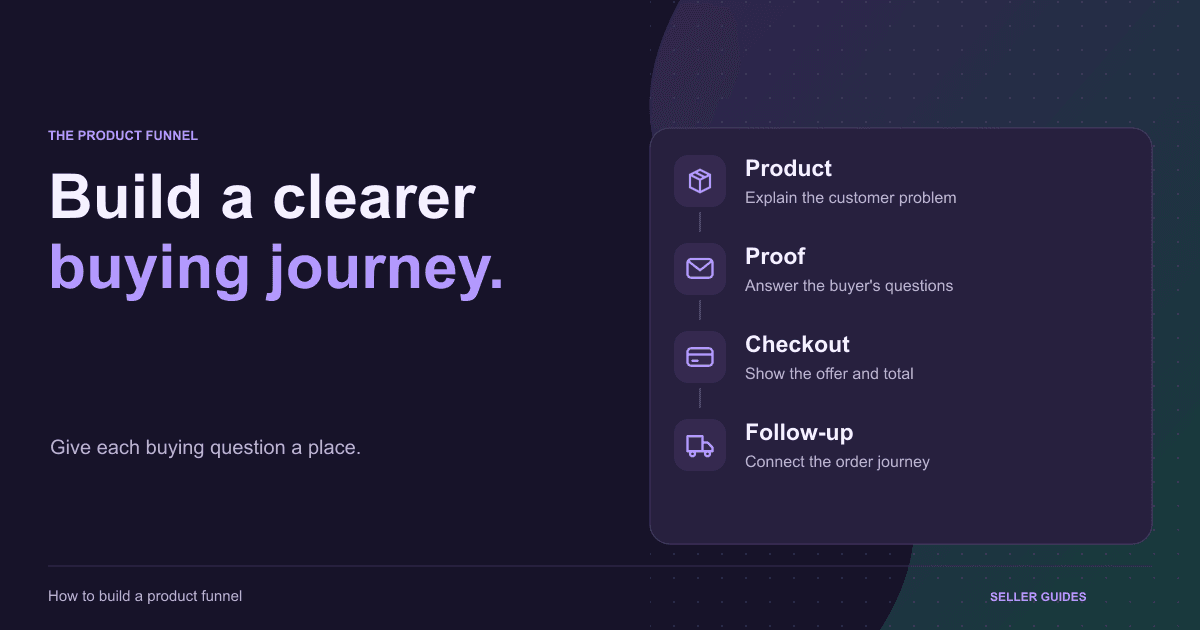
A product funnel is the focused journey that takes a visitor from curiosity to a completed order. Unlike a broad storefront, it gives one product, one customer problem and one buying decision the attention they need. For DTC sellers, that clarity is often the difference between traffic that browses and traffic that buys.
Start with the customer problem, not the product catalogue
Most weak product pages begin with features. A stronger funnel starts with the moment your customer recognises a problem: dry skin before a wedding, a hard-to-clean water bottle, or a daily routine that takes too much time. Open with that moment, then position the product as the practical next step.
Keep the promise specific and believable. Explain who the product is for, what changes after using it, and why the product is different from the alternatives already available.
Give the product story a clear conversion sequence
A high-converting product funnel answers buying questions in the order a customer naturally asks them. Visitors should not need to hunt across menus, product tabs and policy pages to understand the offer.
Use SellSnap AI’s AI product funnel builder to create this focused journey from your product details.
- Lead with a clear product outcome and a supporting visual.
- Show how the product works and the proof behind the claim.
- Make price, offer, delivery information and returns easy to find.
- Use reviews or customer proof near the decision point.
- End each major section with a simple path to checkout.
Make the offer easy to understand
An offer should reduce uncertainty, not create it. State the price, what is included, any bundle savings, and the dates or conditions of a promotion in plain language. If you use COD, prepaid incentives or a limited bundle, show the choice early enough for the buyer to use it.
Avoid stacking too many discounts or pop-ups. One strong reason to buy today is more persuasive than five competing messages.
Treat checkout as part of the funnel
Checkout is not just an operational step. It is where interested visitors decide whether the purchase feels safe and simple. Keep the checkout branded, make payment options clear, and reduce unnecessary fields. Delivery expectations and order communication should be visible before the customer pays.
A connected setup for payments, shipping and customer updates also prevents the experience from breaking after the order is placed.
Explore how branded checkout for DTC sellers can keep the buying experience consistent from first click to order.
Launch, measure and improve one decision at a time
Do not rebuild everything after every campaign. Start by tracking the important stages: landing-page visits, add-to-cart intent, checkout starts and completed orders. Then test one meaningful change, such as the first headline, bundle offer, product proof or checkout incentive.
SellSnap AI helps sellers create and manage this focused journey from one workspace, so the product page, checkout, offers and fulfilment stay connected.
Use product funnel and sales analytics to see where customers move forward and where they hesitate.
BUILD YOUR SELLING SYSTEM
Ready to turn your product story into a focused funnel?
Start a seven-day free trial and build your product funnel, branded checkout and selling operations in one place.
Start your free trialRELATED SELLSNAP AI FEATURES
FAQ
Frequently asked questions
What is a product funnel?
A product funnel is a focused sales journey for one product or offer. It guides a visitor through the product story, proof, offer and checkout rather than sending them into a broad catalogue.
How long should a product funnel be?
It should be as long as needed to answer the buyer’s key questions. Simple products may need a short page, while products with more consideration need deeper proof, explanation and FAQs.
Can I use a product funnel with Meta ads?
Yes. A dedicated funnel lets the page continue the exact promise and angle used in your Meta ad, creating a more consistent journey for the visitor.