
META ADS
Meta Ads Landing Page Best Practices for Product Sellers
Turn more Meta ad clicks into orders with landing-page best practices for product sellers, from message match to checkout and conversion tracking.
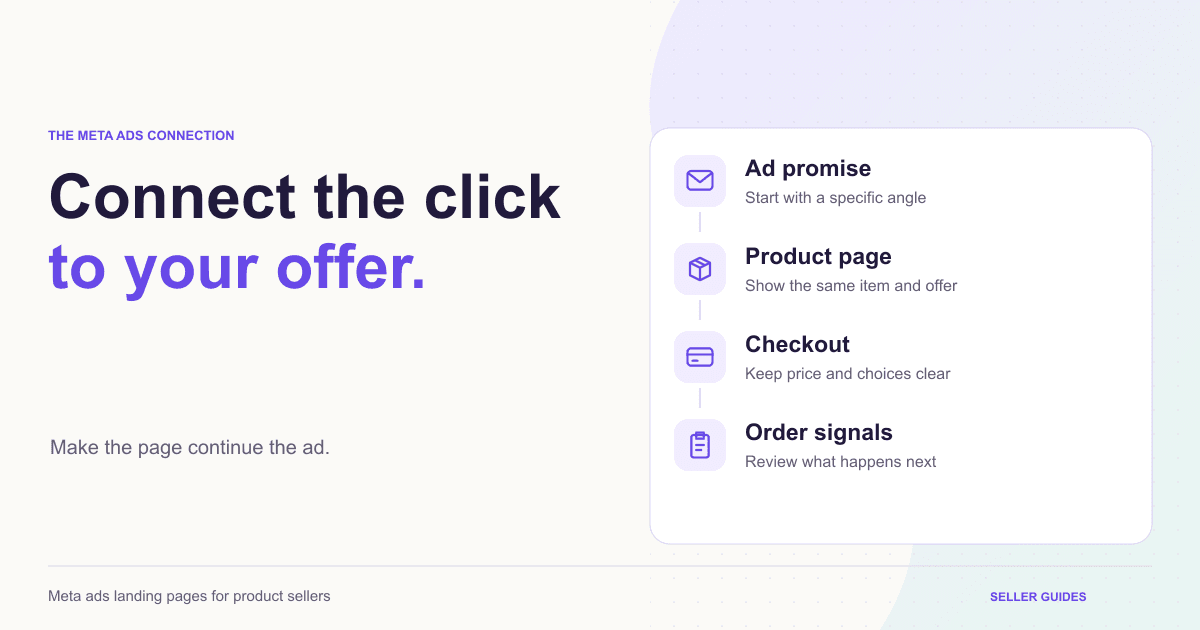
A Meta ad can earn attention in seconds. The landing page has the harder job: it must continue that promise, explain the product and make buying feel straightforward. When an ad sends shoppers to a generic store page, the message often gets lost. A focused landing page gives the campaign a much better chance to convert.
Match the landing page to the ad angle
The first headline on your landing page should feel like the next sentence of your ad. If the ad is about a result, lead with that result. If it highlights an ingredient, a bundle or a problem, make that same idea visible immediately after the click.
Message match reassures the visitor that they have arrived in the right place. It also means you can create different funnels for different angles without making every campaign depend on the same generic product page.
Build focused Meta ads landing pages that continue the campaign promise after every click.
Make the value clear before asking for the sale
Meta traffic is often cold traffic. Do not assume visitors know your brand or product. Use the first screen to establish the product, the outcome and the person it is for. Then support the promise with a product demonstration, useful details, proof and practical buying information.
Strong landing pages are direct, not loud. They use clear headings, scannable sections and visuals that help a customer understand the product quickly.
Build trust near the points of hesitation
Shoppers hesitate around quality, delivery, payment safety and whether the product will work for them. Place credible answers close to the moment those questions appear. Reviews, usage guidance, shipping expectations and return information all reduce friction when they are specific and easy to find.
- Use product reviews that mention real use cases.
- Show the full offer before checkout.
- State shipping and delivery expectations clearly.
- Keep COD and prepaid choices transparent.
- Use a branded, secure checkout experience.
Connect conversion tracking from click to order
Good campaign decisions require clean signals. Connect your Meta Pixel and Conversion API so that key customer actions can be measured more reliably. Track the events that matter to your business, then compare campaign angles against completed orders rather than clicks alone.
Tracking does not replace a clear offer, but it helps you learn which message and audience are producing the strongest buying intent.
See how SellSnap AI supports sales analytics for product sellers alongside your campaign workflow.
Create a repeatable campaign workflow
Choose one hero product, define the customer problem, write one campaign angle, and build the matching funnel. Once the campaign is live, improve the page and creative based on real behaviour. This repeatable approach is easier to scale than rebuilding a whole storefront for every launch.
SellSnap AI brings the product funnel, branded checkout and Meta conversion setup into one workflow for product sellers.
Learn more about conversion funnels for Meta ad sellers before planning your next campaign.
BUILD YOUR SELLING SYSTEM
Ready to turn your product story into a focused funnel?
Start a seven-day free trial and build your product funnel, branded checkout and selling operations in one place.
Start your free trialRELATED SELLSNAP AI FEATURES
FAQ
Frequently asked questions
Should I send Meta ads to my homepage?
Usually no. A homepage has to serve many audiences and products. A focused landing page is better at continuing the exact campaign promise and guiding a visitor toward one action.
What should a Meta ads landing page include?
Include the campaign promise, product outcome, supporting proof, price and offer, reviews, delivery information, and a clear checkout path.
Why connect Meta Pixel and CAPI?
Together they help measure important conversion events more reliably, giving you better information about what is leading to orders.