
BUYING JOURNEY
Payment Link vs Product Funnel: Which Does Your Buyer Need?
Compare payment links and product funnels for Indian product sellers. Choose based on buyer readiness, product questions, COD needs and order fulfilment.
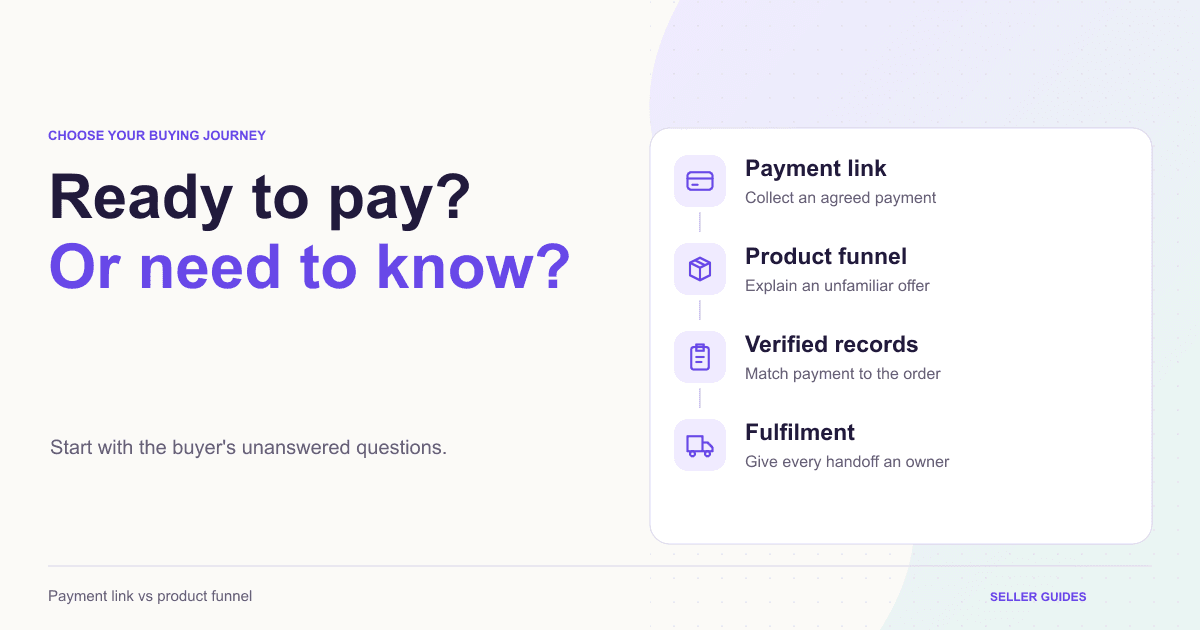
The payment link vs product funnel decision starts with one question: does your customer already understand the offer and want to pay, or do they still need help deciding? A payment link can collect an agreed payment. A product funnel explains an offer and leads toward checkout. Neither automatically produces better sales. Choose around unanswered buying questions and your operating process, not the number of screens alone.
1. Understand the Different Jobs
A payment link sends someone to a hosted payment experience. Features depend on the provider; do not assume every link offers the same product information, payment options or integrations.
A product funnel is the wider journey: introduce a relevant problem, explain the item, present the offer and guide the buyer into checkout. It can use a payment gateway to complete the transaction. This is not secure payment versus insecure payment.
For example, Razorpay's Payment Links documentation describes payment collection without a website and integration with existing systems. Payment links are not inherently disconnected from order tools.
Evaluate an AI product funnel by whether it answers your product's buying questions. More sections are not necessarily better; keep useful information and remove repetition.
2. Check What the Buyer Already Knows
A returning customer may have agreed on the item, quantity, address and final amount. A payment link can be an appropriate next step because the selling conversation already happened.
Someone arriving from a Meta ad for an unfamiliar kitchen accessory may still need dimensions, compatibility and included parts. Asking for payment before answering those questions leaves the offer incomplete.
These are hypothetical situations, not customer results. The same seller can need both routes. Assess the information supplied by each journey rather than assuming purchase intent from the channel alone.
3. Use a Payment Link When the Agreement Is Clear
Make the item, quantity, total and delivery arrangement explicit before sharing the link. Keep an order reference that lets staff match the payment to the correct purchase. Decide how to handle delayed payment or a changed request.
Verify the outcome through your provider or connected records, not only a customer screenshot. Define who acknowledges payment and where fulfilment staff find the order details. Repeatedly explaining the same product and copying choices between conversations can create extra work.
4. Use a Funnel When the Offer Needs Explanation
For an unfamiliar visitor, a focused page provides a consistent explanation. Match the product, bundle and price to the ad or recommendation. Use accurate photographs, specifications and limitations, not unsupported promises.
A creator's Store Link for product selling can organise destinations, but the next page still needs to explain the item. A bio link is an entry point, not a substitute for buying information.
- Use genuine reviews and supportable claims.
- Show what is included and which variant the buyer selects.
- Explain delivery expectations and relevant conditions before commitment.
5. Treat COD and Prepaid as Separate Requirements
Do not assume a payment-link product also creates a COD order or captures every shipping detail you need. Equally, do not assume a funnel supports every payment option without checking its configured checkout.
A COD submission is not collected revenue, and a prepaid payment is not proof of dispatch. Keep these outcomes distinct.
Inspect your branded checkout experience for variants, charges, addresses and payment choices. Test success, cancellation and failure through a controlled process without accidentally triggering real shipments or messages.
6. Compare the Work After Payment
Ask where the accepted order appears, who checks the address and how dispatch is arranged. Include cancellations, refunds and customer questions. A short front-end journey can still create substantial manual work.
Compare subscriptions, applicable transaction charges, external services and staff effort. A lower monthly price does not guarantee lower total costs.
Review the order-management workflow alongside the buying experience. Verify any existing integration rather than assuming manual copying is necessary. Where a handoff is manual, assign a clear owner.
7. Choose the Simplest Complete Journey
Check three things: can the buyer understand the item and amount, can you verify the outcome, and can your team fulfil the correct purchase without guessing?
If an agreed purchase and payment link already meet those needs, extra pages may not help. If the offer needs a repeatable explanation and structured checkout, evaluate a funnel.
Use SellSnap AI's seven-day free trial to evaluate one offer, its mobile buying experience and operational handoff. Choose clarity, not a promise that any tool guarantees sales.
BUILD YOUR SELLING SYSTEM
Ready to turn your product story into a focused funnel?
Start a seven-day free trial and build your product funnel, branded checkout and selling operations in one place.
Start your free trialRELATED SELLSNAP AI FEATURES
FAQ
Frequently asked questions
Is a payment link the same as a product page?
Not necessarily. Providers offer different levels of product information and checkout functionality. Inspect the actual destination rather than judging only its name.
Do funnels replace payment gateways?
No. A funnel describes the selling journey. Online payment processing still requires a supported provider and appropriate setup.
Can I use both routes?
Yes. Repeat customers and unfamiliar visitors may need different journeys. Keep order references, confirmations and fulfilment responsibilities clear.