LAUNCH STRATEGY
Product Funnel vs Ecommerce Website: What Should You Build First?
Compare a product funnel and ecommerce website for your first launch. Choose a practical path for Meta ads, COD checkout, shipping and product discovery.
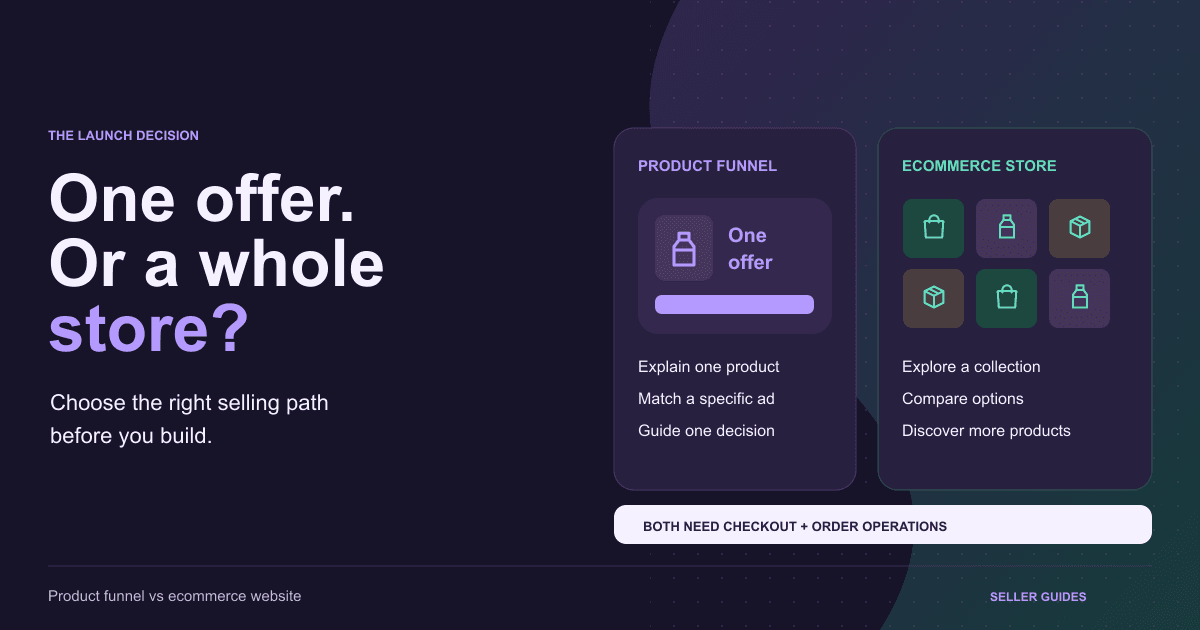
You have a product, a supplier, and an idea for your first Meta ad. The next decision can feel much bigger than it needs to be: should you build a complete ecommerce website or launch a focused product funnel? The right answer depends on what your buyer needs to do. Someone arriving to buy the exact item in a demonstration has a different task from someone exploring a collection. This product funnel vs ecommerce website guide helps Indian product sellers choose a useful starting point, while keeping checkout, payments, and fulfilment in view.
What Is the Actual Difference?
A product funnel is a connected buying journey built around a specific offer. It can include a sales page, product choices, checkout, and order confirmation. It is not simply a long page with several buy buttons.
An ecommerce website is a broader home for a business. It may include categories, search, product pages, brand information, and customer support resources.
The practical question is therefore which journey deserves your attention first.
The approaches overlap. A store can contain dedicated product funnels, and a focused launch still needs business and policy information. Shopify's landing page and website comparison similarly distinguishes a page serving one marketing goal from a website serving several purposes.
Choose a Product Funnel When the Offer Is Specific
A funnel is worth considering when most visitors arrive interested in one product, problem, or offer.
Imagine an ad demonstrating a compact kitchen cleaning tool. The visitor wants to know whether it works on their surfaces, what is included, how much it costs, and how to order. A destination centered on those questions gives the campaign a clear continuation.
This approach also suits a creator recommending a particular product. The recommendation and destination should name the same item and explain the same offer. A funnel is less useful if the visitor must first choose among many unrelated categories.
An AI product funnel builder can help turn product information into a focused page structure. You still need to check the copy, photographs, pricing, and claims before launch.
Choose a Broader Store When Buyers Need to Explore
A broader store can be the better starting point when selection is central to the purchase.
Consider a fashion brand with several collections, sizes, occasions, and price points. Visitors may want to compare items, browse alternatives, or build a basket. Hiding that range behind one long campaign page could make their task harder.
Returning customers may also arrive looking for an item they already know. Clear navigation and product discovery matter in that situation.
Product count alone is not the deciding factor. Ten closely related variants can belong to one focused offer, while three unrelated categories may already need separate paths. Choose the structure around the buying decision, not an arbitrary catalogue limit.
Match the Destination to the Traffic
Before choosing a template, write down where the next group of visitors will come from.
Avoid sending every campaign to the same page simply because that page exists. Equally, do not create a separate funnel for every small wording change.
Build a distinct destination when the audience needs meaningfully different information or a different offer. Keep product facts and prices consistent across those destinations.
For Meta ad sellers, the ad angle gives the destination a useful starting point. A demonstration-led ad should lead to a page that makes the demonstrated use easy to find. A collection advertisement may need a browsing destination instead.
Include Indian Checkout and Shipping Requirements
Neither approach is ready to sell just because the page looks finished.
Check the payment options you intend to offer, the total payable amount, and any COD or prepaid conditions. If you offer a prepaid discount, show how it changes the order summary before the customer commits.
Then check fulfilment: serviceable locations, package details, pickup readiness, shipping charges, and realistic delivery expectations. Confirm what your connected payment and shipping providers require. A page builder does not remove those operational responsibilities.
A branded checkout should make the seller, selected variant, quantity, and next step recognizable. Test the flow on a phone, including validation messages and payment failure handling where your setup supports testing.
Compare the Work Behind the Launch
A useful comparison includes more than the subscription price.
List the work required to create product content, maintain prices, connect services, handle orders, and support customers. Include paid extensions or outside help only when your chosen setup actually requires them.
A focused funnel can reduce the amount of content needed for an initial offer. Multiple independent funnels can also create maintenance work if product details drift between pages.
A broader store may take more initial organization, but shared product records and navigation can support an expanding range.
Look at how order management fits into each option. Trace one order from placement through payment status, dispatch, and customer updates. Note where someone must copy information manually or check another dashboard.
Use Four Questions to Choose Your Starting Point
Write a one-sentence answer to each question:
If the first three answers point to one clear offer, begin by evaluating a product funnel. If comparison and discovery dominate, prioritize the broader store experience.
The fourth question is a readiness check for either path. An unfinished payment or fulfilment process is not solved by choosing a different page layout.
- What did the visitor see immediately before arriving?
- Are they deciding about one offer or comparing a range?
- What information must they understand before ordering?
- Can your team fulfil and support the order through the proposed setup?
Expand After You Learn
Start with the smallest complete buying journey that meets your customer's needs. Complete means the customer can understand the offer, order correctly, and receive appropriate follow-up.
If visitors repeatedly ask for other products, improve discovery. If a strong campaign needs a more specific explanation, add a dedicated funnel within your broader setup.
You do not have to settle your entire website strategy before the first launch.
Use sales analytics alongside payment and shipping records to review results. Separate visits, orders placed, orders delivered, and settled payments instead of treating them as interchangeable measures of success.
BUILD YOUR SELLING SYSTEM
Ready to turn your product story into a focused funnel?
Start a seven-day free trial and build your product funnel, branded checkout and selling operations in one place.
Start your free trialRELATED SELLSNAP AI FEATURES
FAQ
Frequently asked questions
Can I use both a funnel and an ecommerce website?
Yes. A store can support browsing while dedicated funnels serve particular campaigns or offers. Keep product details and operations consistent across both.
Does a product funnel always convert better?
No. Results depend on traffic, the offer, buyer expectations, page usability, and operations. Compare outcomes for similar audiences rather than assuming the layout guarantees a result.
Is one product enough to start?
One product can support a focused launch if its offer and operational setup are ready. That does not remove the need for accurate information, support, and clear policies.
What should I evaluate during a trial?
Build one realistic journey from product information to checkout and order handling. Record missing requirements and manual steps before committing.