
TRACKING VERIFICATION
Meta Pixel and CAPI Testing Checklist Before Your Next Product Campaign
Check your Meta Pixel and CAPI before running ads: verify the destination, purchase meaning, event evidence, duplicate signals and COD versus prepaid reporting.
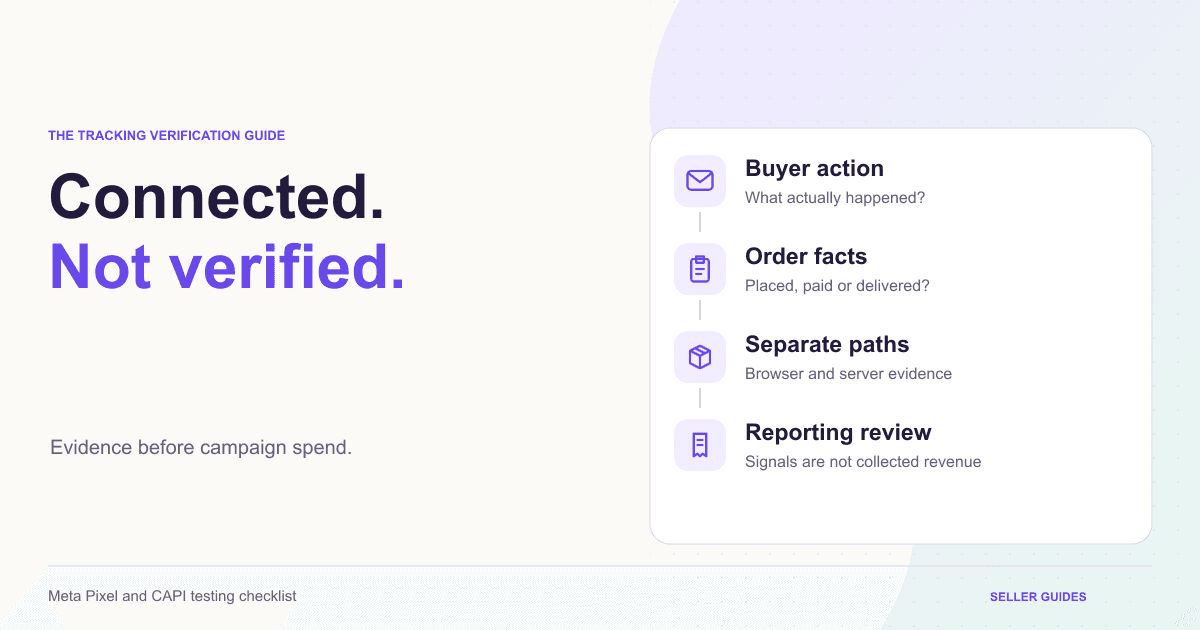
A Meta Pixel CAPI testing checklist should establish which action produced a signal, where it went, what amount it represented and whether it was counted more than once. A connected status is not proof of a correct purchase journey. For Indian sellers, a prepaid payment, a placed COD order and a delivered COD order are different business events. This is a verification guide, not a claim that your current SellSnap tracking has passed these checks.
Set a Safe Test Boundary
Agree who owns the test, which funnel it covers and what actions are allowed. Use controlled contact details and an appropriate test environment where available. Do not use a real customer's identity just to make an event appear.
Payment test mode does not necessarily isolate shipping, email or other connected services. Confirm those boundaries separately. If a live transaction is necessary, agree its amount and cleanup process beforehand.
Identify the Intended Destination
Record the funnel URL and intended Meta event destination. Confirm the reviewer has access to the correct business assets; similar account names are not enough. List every potential sender, including app integrations, manual scripts and tag managers, before changing anything.
Review the Meta ads funnel setup alongside actual connected settings. Keep access tokens and unnecessary customer details out of shared evidence.
Define What Purchase Means
For prepaid orders, distinguish order creation, a payment attempt and verified payment success. For COD, distinguish accepting an order from collecting money or delivering the parcel.
If an implementation reports an accepted COD order as a purchase signal, do not describe that signal as collected revenue. Document the trigger and make sure the team interprets it consistently.
Use the order-management workflow to keep the underlying order reference and status traceable. Compare tracking with operational facts.
Follow Browser and Server Evidence Separately
For one controlled journey, list the expected actions: product viewed, checkout opened, payment attempted and the agreed conversion milestone. Ask the implementer which actions are sent by the browser, the server or both.
Inspect the current testing tools and application logs. Browser evidence does not prove server delivery; server submission does not prove correct advertising attribution. Mark each expected signal observed, missing or unresolved, linked to a non-sensitive reference and timestamp.
Check Amounts and Repeated Actions
Compare the tracking amount with its documented meaning and the saved order, including discounts, shipping and accepted add-ons. Order value and money collected can differ. A hypothetical INR 1,000 order with INR 200 collected upfront illustrates that distinction, not a promised workspace capability.
Review branded checkout so the buyer-facing total, order record and event value can be explained together.
- Check whether refreshing confirmation or returning from payment repeats the same conversion.
- Where both paths report one conversion, request evidence of the deduplication mechanism; an order reference alone is not proof.
- Confirm implementation details against current Meta documentation rather than relying on an old code snippet.
Review Data Sharing and Reporting
Document what information is sent and how configured privacy choices affect both browser and server paths. Server reporting should not be treated as permission to ignore those choices. Have the responsible owner review applicable requirements; this checklist is not a legal compliance assessment.
Keep a small evidence sheet with the action, order outcome, expected signal, observed result and next check. Separate COD and prepaid rows and assign an owner to unresolved issues.
Compare sales analytics with gateway and order records. Event receipt, attribution, collected revenue and delivered orders are different measurements; do not expect every dashboard total to match immediately.
Evaluate Before Scaling Traffic
Start SellSnap AI's 7-day free trial to prepare a funnel and review its purchase journey. Document unresolved tracking checks before increasing spend. Better evidence supports clearer decisions, not guaranteed attribution or profitable advertising.
Compare the available SellSnap AI plans and confirm your implementation with its owner before launch.
BUILD YOUR SELLING SYSTEM
Ready to turn your product story into a focused funnel?
Start a seven-day free trial and build your product funnel, branded checkout and selling operations in one place.
Start your free trialRELATED SELLSNAP AI FEATURES
FAQ
Frequently asked questions
Does connected mean purchase tracking works?
No. Verify a controlled journey and compare the signals with the actual order and payment outcome.
Should COD purchases equal collected revenue?
Not automatically. Establish the trigger first. A placed COD order may still be cancelled, returned or awaiting collection.
Does this prove SellSnap CAPI is fully verified?
No. These are checks to perform, not completed test results. Confirm current capabilities, implementation and observed evidence in your workspace.